

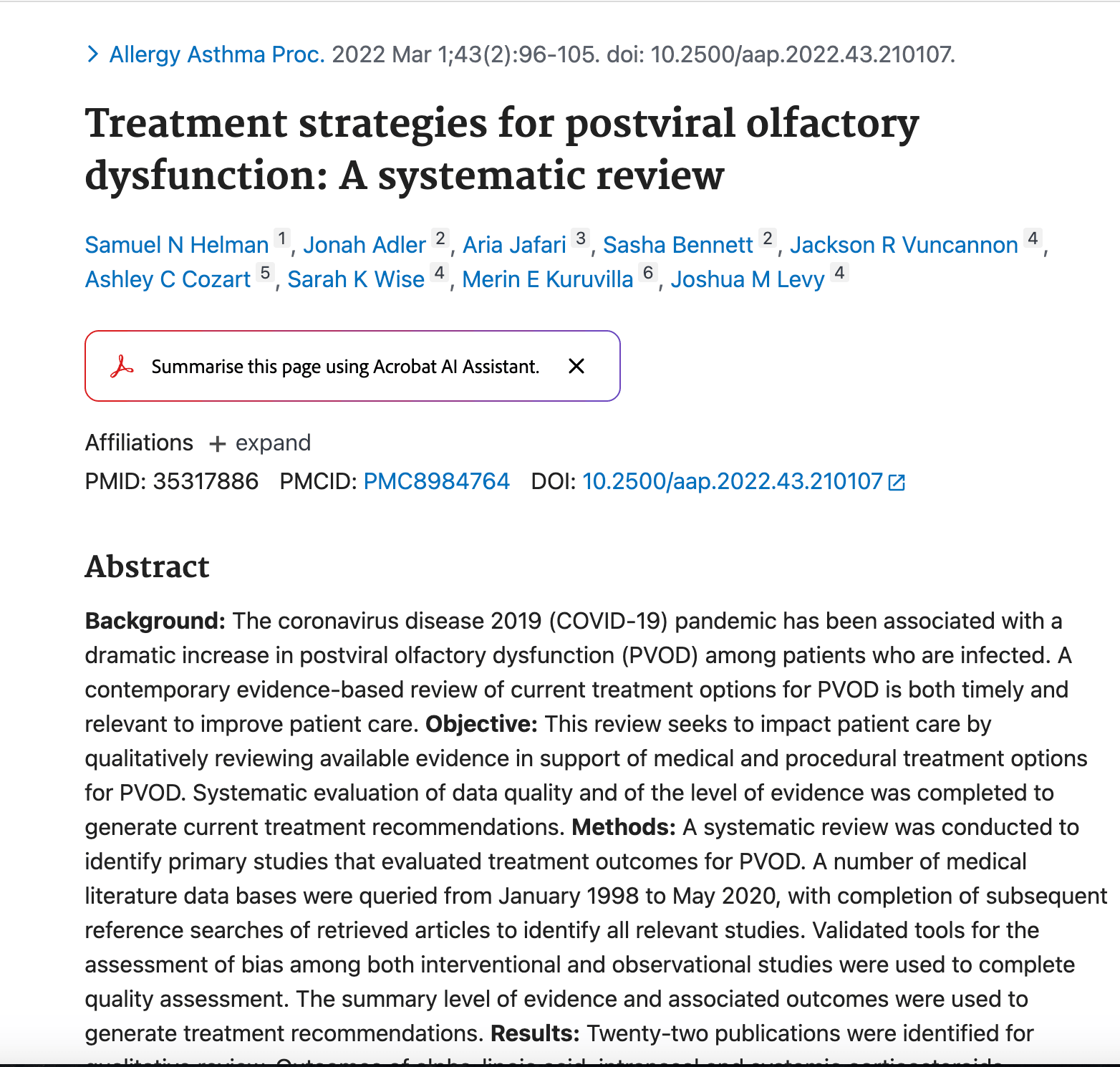
Post-viral loss of smell, also called post-viral olfactory dysfunction (PVOD), means losing all or part of your sense of smell after a viral infection. Researchers have studied a range of medicines, supplements and other treatment options. Overall, olfactory training has the strongest evidence and is the treatment the research supports most clearly as a first choice. Most other treatments have much weaker or conflicting evidence.
Treatments for post-viral loss of smell supported by research
Olfactory training (OT) — SUPPORTED; best evidence
Olfactory training involves deliberately smelling several strong scents — commonly eucalyptus, lemon, rose and cloves — regularly over a period of months.
Seven studies involving 447 people were reviewed, including several higher-quality studies. Overall, OT improved objective measures of smell compared with no treatment or control groups. Benefits were sometimes clearer after 16–32 weeks, and some studies found that improvement continued after training stopped. The review therefore recommends olfactory training as the first-line treatment for PVOD. Longer training may be helpful.
Topical corticosteroids — SOME SUPPORT, but limited evidence
Steroid treatment applied inside the nose, including mometasone, has shown improvements in some studies. One study using a steroid injection near the smell-sensing area reported improvement in about half of patients. However, the evidence is limited, and the review does not consider steroids as strongly established as olfactory training. They may be considered in selected patients, particularly when inflammation is also present.
Vitamin A / retinoic acid — MIXED evidence; still uncertain
Vitamin A helps repair the nerve cells of the olfactory system. Oral vitamin A at 10,000 IU did not outperform placebo. However, 10,000 IU of vitamin A applied topically in combination with olfactory training produced better results than training alone in one study. This makes topical vitamin A promising but not established. More evidence needed.
Sodium citrate nasal spray — PROMISING, but experimental
Sodium citrate may temporarily change how calcium affects smell signalling. Some patients with PVOD showed improved ability to identify smells, and detection of several smells improved compared with sterile water. However, it did not clearly outperform saline in one comparison. The evidence is therefore encouraging but insufficient for routine treatment.
Traditional Chinese acupuncture — PROMISING, but limited evidence
Two small studies found better smell-test results after acupuncture than after control treatments. Around 80 people were studied in total. The results are encouraging, but the evidence base is too small to establish acupuncture as a proven treatment.
Treatments for post-viral loss of smell not supported, or not yet proven
Systemic (oral) corticosteroids — NOT SUPPORTED
The review found insufficient evidence of benefit and recommends against relying on systemic steroids for PVOD.
Zinc sulphate — NOT SUPPORTED
Zinc did not improve patients’ reported symptoms compared with topical corticosteroids. The research therefore does not support zinc supplementation as a treatment for PVOD.
Minocycline — NOT SUPPORTED by current evidence
Although it has potentially protective effects on nerve cells and looked promising in animal studies, it did not produce a significant improvement over placebo in human PVOD patients.
Ginkgo biloba — NOT SUPPORTED
Adding Ginkgo biloba to systemic and topical corticosteroids did not provide a statistically significant additional benefit.
Alpha-lipoic acid — INCONCLUSIVE
One study reported improvements in smell-test measures, but there is not enough rigorous research to recommend it.
Caroverine — EXPERIMENTAL
Caroverine improved some measures of smell compared with zinc sulphate, but the evidence comes from limited research and is not strong enough to establish it as a standard treatment.
Theophylline — EXPERIMENTAL/UNCERTAIN
Oral theophylline has produced improvements in smell in some studies, with greater effects at higher doses and while treatment continued. However, the evidence is not sufficiently rigorous for the review to recommend it routinely. Despite being mentioned as a possible option in selected patients, the review ultimately states that there is not enough rigorous evidence to make a firm recommendation.
Intranasal insulin — EXPERIMENTAL
Insulin sprayed into the nose improved smell thresholds in about 60% of patients in one study and made smells seem more intense than with placebo. However, the research is limited, so this remains experimental.
Vitamin B — INSUFFICIENT EVIDENCE
Vitamin B was used as a control treatment in an acupuncture study, but there is not enough evidence from the reviewed research to conclude that vitamin B treats PVOD.
What does this mean if you have post-viral loss of smell?
The research points most clearly towards olfactory training. That does not mean it will work for everyone, or that other treatments can never help. It means that, among the treatments covered by this review, olfactory training has the strongest evidence behind it.
If you would like to learn more about how to do olfactory training, CKOS has a guide to smell training, including practical information to help you get started.
If you are considering medicines, supplements or other treatments, it is worth discussing them with a healthcare professional. In particular, treatments such as steroids and vitamin A can have risks or need to be used in specific ways, so they should not simply be started without appropriate medical advice.
Source article
This post is based on “Treatment strategies for post viral olfactory dysfunction: A systematic review”, which looked at the evidence for olfactory training and a range of medicines, supplements and other treatments.
Bottom line
Of the treatments studied in this review, olfactory training has by far the clearest research to support it, and is recommended as the first-line treatment. Topical nasal steroids, sodium citrate, topical vitamin A and acupuncture are possible options in carefully selected patients, but the evidence is considerably weaker.
Alpha-lipoic acid, caroverine, Ginkgo biloba, intranasal insulin, minocycline, theophylline and vitamin B remain experimental or insufficiently studied. Zinc sulphate is not supported by the available evidence. Systemic corticosteroids are more complicated: this particular review does not support relying on them for PVOD, while other evidence-based guidance suggests they may be considered for selected patients after weighing the risks and limited evidence.
Importantly, “experimental” does not necessarily mean that a treatment cannot work. It means that there is currently not enough high-quality research to know reliably whether it works, for whom, or what the risks and benefits are.
Key Takeaway
Olfactory training currently has the clearest support as a treatment for post-viral loss of smell. Other treatments have been studied, but the evidence is generally much weaker or still uncertain.

